
The ten categories of ancestral mezcal
Mezcal can get very confusing for the average consumer. You’ve got regular Mezcal, Mezcal Artesenal, and Mezcal Ancestral. And then there are variations among those, including Joven, Reposado, Anejo, abocado con, destilado con, and on and on. But this, it seems, is part of the heritage of Mezcal — at least according to a 1904 book titled Diccionario de Aztequismos o Sea Catalogo de las Palabras del Idioma Nahuatl, Azteca ó Mexicano, Introducidas al Idioma Castellano Bajo Diversas Formas. (That’s Dictionary of Aztecisms, or a Catalog of Words from the Nahuatl, Aztec, or Mexican Language Introduced into the Spanish Language in Various Forms, and, yes, that is the longest title ever for a book.) In that book, there are ten categories of mezcal. Want to know what they are…?
Agave Road Trip is a critically acclaimed, award-winning podcast that helps gringx bartenders better understand agave, agave spirits, and rural Mexico. This episode is hosted by Lou Bank with special guest Linda Sullivan of seynasecreto.
Episode Notes
Read Diccionario de Aztequismos o Sea Catalogo de las Palabras del Idioma Nahuatl, Azteca ó Mexicano, Introducidas al Idioma Castellano Bajo Diversas Formas, by Cecilio Agustín Robelo (1904), for the source of the quoted passage in this episode:
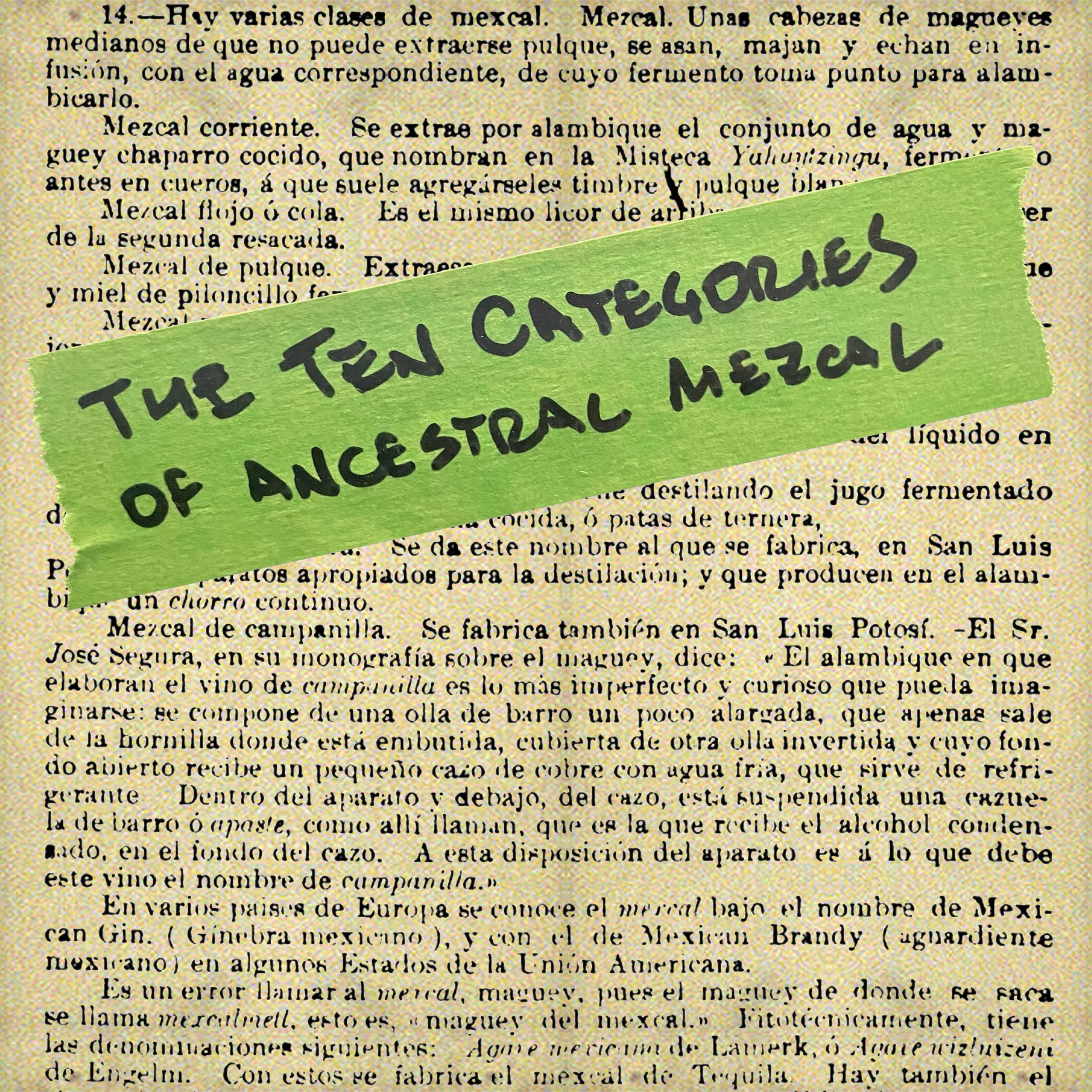
There are several types of mezcal.
Mezcal: Heads of medium-sized maguey plants—from which pulque cannot be extracted—are roasted, crushed, and steeped in the appropriate amount of water; the resulting ferment is then ready for distillation.
Mezcal corriente (Standard Mezcal): Distilled from a mixture of water and cooked chaparro maguey (known in the Mixtec region as Yahuytzingu), which has been fermented in animal-skin bags; white pulque is often added to the mixture.
Mezcal flojo or cola (Weak Mezcal or "Tail" Mezcal): The same liquor as above, but resulting from a second distillation.
Mezcal de pulque: Distilled from a mixture of tlachique pulque and piloncillo (unrefined cane sugar) syrup, fermented in animal-skin bags.
Mezcal resacado de cola (Redistilled "Tail" Mezcal): Produced by redistilling mezcal cola to improve its quality; the volume is reduced to one-quarter of the original.
Mezcal resacado corriente (Redistilled Standard Mezcal): Produced by redistilling mezcal corriente; the volume is reduced to one-quarter.
Mezcal de cabezas (Head Mezcal): Obtained by distilling the liquid in which the maguey heads were fermented.
Mezcal de sustancia (Substance Mezcal): Obtained by distilling the fermented juice of the maguey heads together with cooked chicken meat or veal trotters.
Mezcal de chorrera (Stream Mezcal): This name is given to mezcal produced in San Luis Potosí using specialized distillation apparatuses that yield a continuous stream from the still.
Mezcal de campanilla (Bell Mezcal): Also produced in San Luis Potosí. Mr. José Segura, in his monograph on the maguey, states: "The still used to produce vino de campanilla is the most imperfect and curious apparatus imaginable: it consists of a somewhat elongated earthenware pot—barely protruding from the hearth in which it is embedded—covered by another inverted pot; the latter's open bottom holds a small copper vessel filled with cold water, which serves as a condenser. Suspended inside the apparatus, beneath this vessel, is an earthenware bowl—or apaste, as it is locally known—which catches the alcohol condensing on the bottom of the vessel. It is to this specific arrangement that the spirit owes the name campanilla."
In several European countries, mezcal is known as "Mexican Gin," while in some U.S. states, it is referred to as "Mexican Brandy."
It is a mistake to call the plant itself maguey; the specific maguey from which it is derived is called mexcalmetl—that is, "mezcal maguey." Botanically, it is classified as Agave mexicana (Lamarck) or Agave wizlizeni (Engelmann); Tequila-style mezcal is produced from these varieties. There is also Agave decipiens, which is harvested in Texas, New Mexico, and Chihuahua.
Shout outs this episode to Google Books, Daniel Moen, Marco & Andrea at Mezcouting, the book El Maguey (1901), Mezcal Villasuso, Mezcal Campanilla, and the lie about gusanos only being marketing.
Ad Links
The street taco of Tequilas? For me, that’s Tequila El Viejito! Always great, always worth a taste!
Chicotona Mezcal honors tradition while always looking for something better. Try a taste of family, culture, and tradition!
Head out on an Agave Road Trip with Finca 18! Greg Rutkowski will take you on his Agave Road Trip Route #2 - Raicilla de la Costa! Price includes a bottle of Paulo Rodriguez’s fabled, limited Tumbado batch!
Order beautiful spirits to be delivered to anywhere in Mexico — beautiful or otherwise — through Agave Spirits Presents!